
You have probably seen “ETA” in a message and paused for a second, wondering what it actually means. It shows up in chats, delivery updates, and even work conversations, but not everyone understands it right away. In simple terms, ETA is just a quick way of talking about time specifically when someone is expected to arrive or finish something. People use it because it saves time and keeps messages short and clear.
In this article, we will break down what ETA means, where it’s used, and how you can understand it easily in everyday conversations.
What Does ETA Mean in Texting?
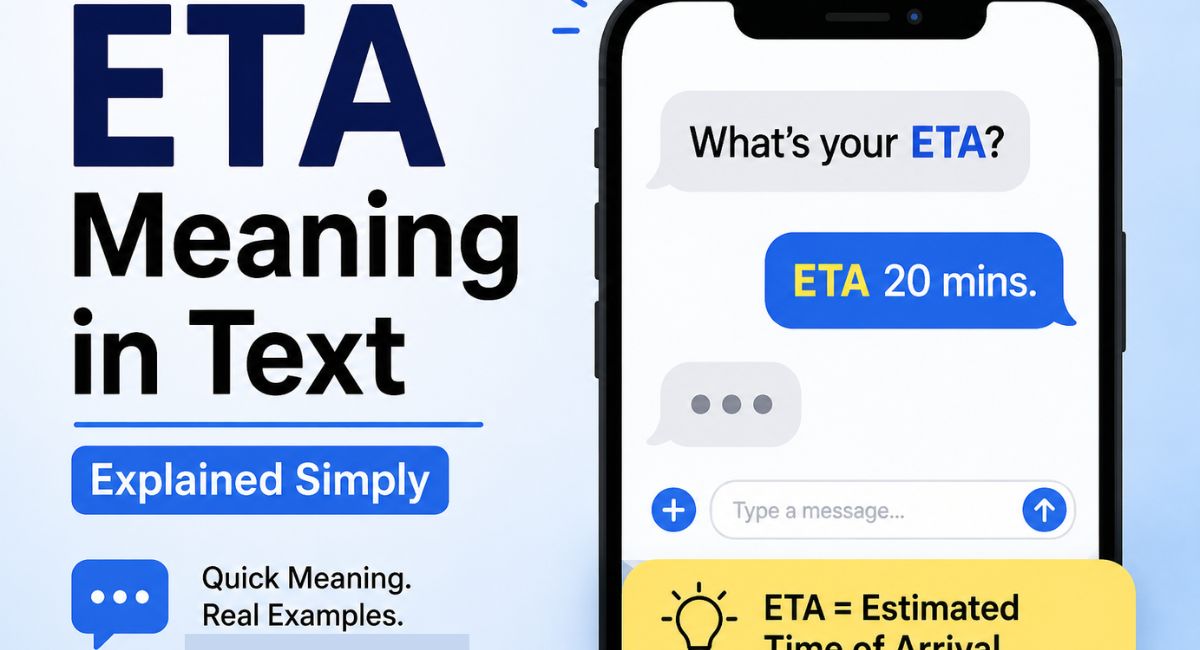
ETA stands for estimated time of arrival. When someone sends you “ETA?” in a text, they’re asking when you expect to show up, finish something, or deliver a result. It’s a quick, no-fuss way of asking when without writing out a full sentence.
The word “estimated” is doing a lot of work here. It signals that the answer doesn’t have to be precise; it’s a best guess, a ballpark figure, a working assumption. That’s part of why ETA feels so natural in casual texting. You’re not committing to a deadline; you’re giving someone enough information to manage their expectations.
The Full Form of ETA
The full form estimated time of arrival has been around long before smartphones existed. In its traditional sense, it referred to the predicted moment a ship, aircraft, or vehicle would reach its destination. Today, texters use it far more loosely, applying it to everything from their commute to a work report to a meal they’re cooking.
So when your roommate texts “ETA on dinner?” they’re not filing a logistics report. They’re just hungry and curious.
ETA in Everyday Chat vs. Formal Use
In casual texting, ETA is conversational shorthand. Nobody spells it out. Nobody capitalizes it with ceremony. It flows naturally into messages the same way “lol” or “brb” does.
In formal or professional settings think project updates, customer service chats, or business emails ETA carries a slightly more serious tone. A project manager asked “What’s the ETA on the report?” expects a real answer, not “lmk soon.” The acronym crosses between worlds effortlessly, which is a big reason it’s lasted so long in digital communication.
Where Did ETA Come From? A Quick History
Most texting slang is relatively young, born in the 2000s or 2010s. ETA is older and more interesting than that.
Military and Aviation Roots
ETA originated in military and aviation contexts, where knowing the precise arrival time of aircraft, ships, and troops was operationally critical. Flight dispatchers, naval commanders, and air traffic controllers relied on ETA calculations long before anyone owned a mobile phone. It appeared in official logs, radio communications, and mission briefings as standard shorthand.
Airlines adopted it heavily in scheduling. Cargo logistics companies baked it into their tracking systems. By the time the internet arrived, ETA was already a well-established piece of professional vocabulary.
How ETA Moved Into Digital Communication
As instant messaging platforms proliferated in the late 1990s and early 2000s, ETA made the leap from technical jargon to everyday language. Early internet chatrooms and AOL Instant Messenger users started dropping it casually. Then came SMS, smartphones, and social media and ETA just kept spreading.
Today, it belongs as much to a teenager texting their friend as it does to a shipping company updating a customer. That crossover is rare for technical acronyms, and it’s a testament to how universally useful the concept of “when will you get here?” really is.
IFG Meaning Explained in Text Messages for 2026 (Full Guide)
How ETA Is Used Across Different Platforms
The context shifts depending on where the conversation is happening, but the core meaning stays consistent.
ETA in WhatsApp and iMessage
These are the most common places people type ETA in a purely social context. Someone running late to a get-together, a parent waiting for their kid to come home, a group of friends coordinating at a festival all of them might fire off a quick “ETA?” without thinking twice. The informality here is total. Lowercase, no punctuation, often just the three letters standing alone.
Sometimes it appears in a fuller sentence: “Hey, what’s your ETA?” or “Text me your ETA when you leave.” Both are completely natural.
ETA in Instagram DMs and TikTok Comments
On Instagram, ETA appears most often when someone is asking about a creator’s next post, a product restock, or a response to a message. “ETA on your next video?” is a fan asking when more content is coming. It’s softer and more casual, less urgent, more curious.
On TikTok, you’ll see it in comment sections when a creator teases something upcoming. “ETA on part 2??” is basically a digital drum roll. The platform’s fast-paced culture makes short abbreviations like ETA a natural fit.
ETA in Gaming and Multiplayer Chats
Gaming communities have their own language, and ETA is a staple. In multiplayer games, coordinating timing is everything when teammates are respawning, when someone’s loading in, when the squad will be ready to move. “ETA on respawn?” or “ETA till you’re back online?” are standard questions in gaming chats, Discord servers, and party lobbies.
In this context, ETA is less about physical travel and more about coordination and timing. Still the same idea, just applied to a virtual environment.
ETA in Slack, Teams, and Professional Messaging
Workplace messaging platforms have fully embraced ETA as part of their communication shorthand. Colleagues use it constantly for project updates, meeting prep, and task management. “ETA on the client proposal?” in Slack is a professional nudge. It’s efficient, it’s direct, and it doesn’t sound aggressive the way “when will this be done?” might.
In remote and hybrid teams especially, where face-to-face check-ins are limited, ETA has become a key word for maintaining workflow transparency without micromanaging. It creates accountability while still leaving room for honest, flexible responses.
Real-Life ETA Examples in Text Conversations
Reading about a word is one thing. Seeing it in action makes it click.
Casual Texting Examples
Friend: heading to your place now You: nice, ETA? Friend: like 20 mins maybe
Or consider a group chat:
Alex: we’re still getting ready Jordan: ugh ok what’s your ETA Alex: 30 mins tops, sorry!
These feel completely natural because ETA slots in as a relaxed, low-pressure question. Nobody reads it as demanding.
Professional and Work Scenarios
Manager (Slack): Hey, ETA on the Q3 slides? Employee: Should be done by 3 PM today just wrapping up the last section.
Or in email:
“Could you share an ETA for the final deliverables? The client is following up.”
Here, ETA keeps things concise and professional without sounding cold or terse.
Dating and Social Coordination
ETA comes up naturally in early-stage dating too, especially for coordinating meetups:
Text: On my way! ETA like 10 minutes. Reply: Perfect, I just got here, grab a drink on your way in!
It removes awkwardness by giving information proactively. You’re managing expectations without making a big deal of it.
How to Respond When Someone Asks for Your ETA
Knowing how to reply is just as important as knowing what ETA means.
When You Know the Time
Be specific, but keep it natural. “About 15 minutes” or “I’ll be there by 7:30” works perfectly. You don’t need to use the acronym back at them unless it fits your style.
When You’re Running Late or Uncertain
Honesty and an updated estimate go a long way. “Running a little behind probably 20-25 minutes now, sorry!” signals that you’re communicating, not ghosting. People appreciate an updated ETA far more than silence.
If you genuinely don’t know: “Not sure yet, I’ll text you when I leave” is a perfectly valid response. An honest “no ETA yet” is better than a fake one.
Polite Ways to Ask for Someone Else’s ETA
Instead of a bare “ETA??” which can feel sharp in some tones, try softening it slightly: “Hey, any idea on your ETA?” or “Just checking roughly when do you think you’ll arrive?” Both feel warmer without losing the efficiency of the question.
ETA vs. Similar Abbreviations — What’s the Difference?
ETA often gets compared to other timing-related shorthand, and knowing the distinctions matters.
ETA vs. ETD
ETD stands for estimated time of departure, and it’s the natural twin of ETA. While ETA tells you when someone arrives, ETD tells you when they’re leaving. You’re more likely to see ETD in aviation, shipping, and formal logistics contexts than in everyday texting. Most people don’t need to say “ETD” in a text; they just say “I’m leaving at 10.”
ETA vs. ASAP
ASAP — as soon as possible communicates urgency rather than a specific time. When your boss says “I need this ASAP,” they’re not giving you a timeline; they’re telling you to prioritize. ETA, on the other hand, asks for or provides an actual time estimate. The two can appear in the same message: “Can you get this done ASAP? What’s your ETA?”
ETA vs. EOD
EOD means end of day, and it’s very common in professional messaging. It implies a deadline (today, before the business day closes) rather than a predicted arrival time. “Can I have this by EOD?” is a soft deadline. “What’s your ETA on this?” is an open question. The distinction is deadline vs. estimate.
ETA vs. OTW
OTW — on the way — is the casual cousin of ETA. Saying “OTW” tells someone you’ve started moving toward them. ETA tells them when you expect to get there. They often appear together: “OTW, ETA for like 15 mins.” Efficient, informative, and totally natural in a casual text.
ETA Beyond Texting — Other Places You’ll See It
ETA doesn’t stay confined to personal conversations. It runs through several important industries.
ETA in Logistics and Package Tracking
Every time an e-commerce site shows you “Estimated Delivery: Thursday, May 22,” that’s ETA in action. Shipping platforms, courier services, and order tracking systems are built on real-time ETA calculations. The figure changes dynamically based on carrier updates, traffic, and weather, which is why you’ll sometimes see a notification saying your estimated delivery time has been updated. That’s a revised ETA, and it’s critical for managing customer expectations in online retail.
ETA in Ride-Sharing Apps
Apps like Uber and Lyft have made ETA impossible to miss. The moment you request a ride, the app shows your driver’s ETA in real time updating as they navigate through traffic. This live ETA tracking is one of the most familiar uses of the concept for most people today, and it’s helped normalize the term for anyone who hadn’t encountered it before.
ETA in Aviation and Transportation
Airlines publish ETAs for all incoming and outgoing flights. Train schedules, ferry timetables, and bus apps all rely on ETA calculations. When a flight is delayed and the departure board updates, that new number is a revised ETA based on current conditions. For anyone who travels regularly, ETA is a constant companion.
ETA in Healthcare and Emergency Response
In emergency medicine, ETA takes on genuine urgency. Emergency dispatchers relay the ETA of paramedics to hospitals so trauma teams can prepare. “Patient ETA 4 minutes” in an ER context means a very specific, life-affecting countdown. The stakes here are a world apart from “ETA to the pizza place,” but the core concept of predicting when something or someone will arrive is exactly the same.
Common Mistakes People Make with ETA
Even simple terms get misused sometimes.
Treating ETA as an Exact Time
The E in ETA stands for estimated. That means it’s a prediction, not a promise. One of the most common frustrations in conversations is when someone takes an ETA as a guarantee and then reacts poorly when timing shifts slightly. If a colleague says “ETA end of day,” they’re communicating a target, not a contractual deadline. Reasonable flexibility around ETAs keeps communication healthy.
Not Updating Your ETA When Plans Change
Giving an ETA and then going silent when things change is a communication breakdown. If your original estimate shifts significantly, a quick “Hey, running about 20 minutes behind my earlier ETA” is all it takes. People don’t mind delays nearly as much as they mind being left guessing. An updated ETA shows respect for someone else’s time.
Why ETA Has Become Such a Powerful Communication Tool
ETA works because it solves a genuinely human problem: uncertainty. We’re all navigating schedules, commitments, and unpredictable circumstances. Having a word that captures “here’s my best prediction of when I’ll get to you” is enormously useful.
Expectation Management in the Digital Age
Modern communication is fast, and unanswered timing questions create anxiety. Will they be here in five minutes or forty-five? Should I wait, or move on with something else? An ETA collapses that uncertainty into something manageable. It’s a small act of consideration — giving someone information so they can plan accordingly. That’s why it feels natural to both ask for and offer an ETA. It’s not demanding. It’s collaborative.
ETA in Remote Work and Hybrid Teams
With remote and hybrid work becoming the norm, teams no longer have the visual cues of seeing a coworker at their desk. ETA fills part of that gap. When you tell a teammate “I’ll have the draft to you by 2 PM,” you’re providing an ETA that helps them organize their own workflow around yours. It’s one of the reasons communication-focused platforms like Slack have baked it into their culture naturally. Clear timing communication is a form of professional respect, and ETA is a shorthand way of practicing it.
Frequently Asked Questions
What does ETA mean in a text message?
ETA stands for estimated time of arrival. In texting, it’s used to ask or tell someone when you expect to show up, complete a task, or deliver something. It’s one of the most versatile and commonly used abbreviations in both casual and professional digital communication.
Is ETA only used for travel and physical arrival?
Not at all. While ETA originally referred to the arrival of vehicles or aircraft, in modern texting it applies to almost any situation involving timing. People use it for task deadlines (“ETA on the report?”), content releases (“ETA on the next episode?”), and even responses (“What’s the ETA on your decision?”). The concept has stretched well beyond its transportation origins.
How do you respond if you don’t know your ETA?
The most honest and respectful response is to say exactly that. Something like “Not sure yet I’ll text you when I’m on my way” or “No ETA right now, still figuring out my schedule” works perfectly. Giving a vague ETA is less helpful than admitting you don’t have one yet.
What’s the difference between ETA and OTW?
OTW means on the way, indicating that you’ve already started moving. ETA gives the predicted time of arrival. The two are complementary and often appear together: “OTW now, ETA about 15 minutes.” OTW is about status; ETA is about timing.
Can ETA be used in formal emails and business communication?
Absolutely. ETA is widely accepted in professional contexts, especially in project management, customer service, and corporate messaging. Phrases like “Please provide an ETA for the deliverables” or “What is your ETA on completing the review?” are standard and professional. In very formal documents or external reports, it may be worth spelling out “estimated time of arrival” on first use, but in day-to-day business communication, ETA stands fine on its own.
Why does ETA sometimes change after it’s been given?
Because it’s an estimate, not a guarantee. Real-world conditions traffic, delays, technical issues, competing priorities can all shift timing after an initial ETA is communicated. When that happens, the polite and professional move is to proactively share an updated ETA rather than waiting to be asked again.
Final Thoughts
ETA is one of those rare pieces of language that bridges the gap between technical precision and casual human conversation. It started in the cockpits and control towers of aviation, traveled through military operations and shipping logistics, and eventually landed in your text messages all without losing its usefulness or clarity.
Whether you’re texting a friend, coordinating a team project, tracking a package, or navigating rush-hour traffic, ETA gives you a clean, simple way to manage the one thing everyone cares about: time.
The next time you get that familiar “ETA?” from someone, you’ll know it’s not just a question about minutes and miles. It’s someone trusting you enough to ask for your best estimate, so they can make their own plans accordingly. That’s a small but meaningful piece of communication and now you’ve got the full picture.