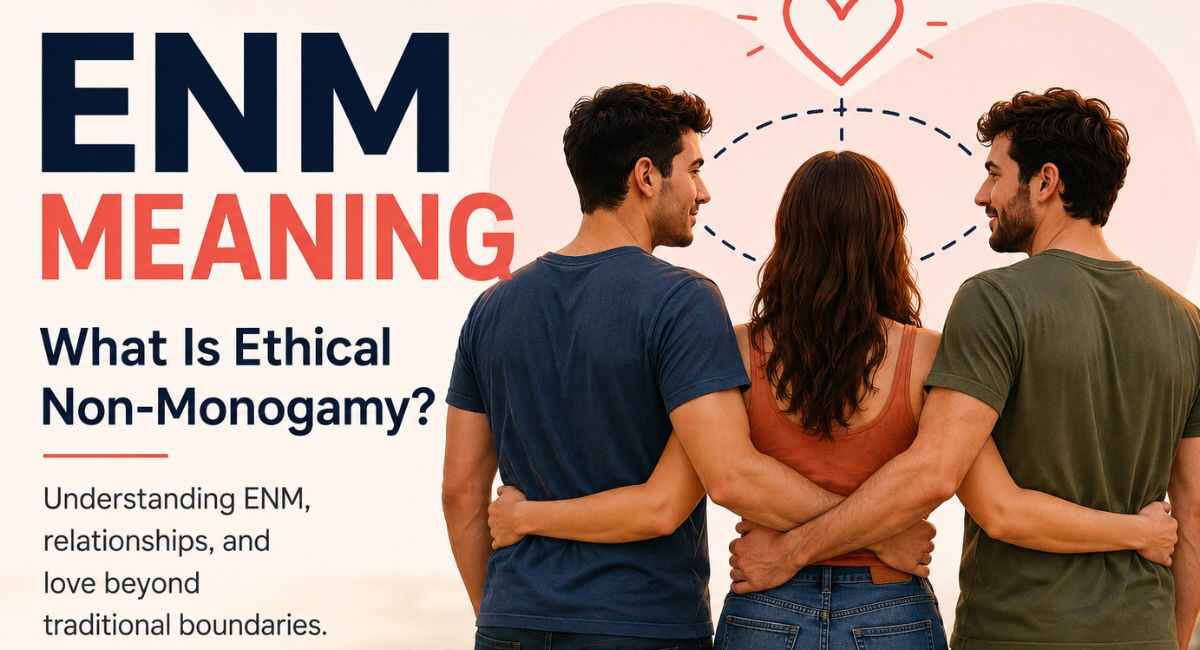

Many people today are curious about different types of relationships, and one term that keeps showing up is Ethical Non-Monogamy, also called ENM. Unlike traditional relationships where two people stay exclusive, ENM allows partners to have romantic or sexual connections with others but only with honesty, trust, and full consent from everyone involved.
For some people, this relationship style brings more freedom, better communication, and deeper emotional understanding. In this guide, you’ll learn what ENM really means, the different types of ENM relationships, and why more people are openly talking about it today.
What Does ENM Mean? A Clear Definition
Ethical Non-Monogamy (ENM) refers to any intimate relationship structure in which all involved partners openly consent to having multiple romantic, emotional, or sexual connections simultaneously. The term is also used interchangeably with Consensual Non-Monogamy (CNM).
The core of ENM sits on three pillars: consent, transparency, and mutual respect. Without all three, it stops being ethical and starts being something else entirely. People practice ENM for all kinds of reasons, ranging from a desire for emotional variety, to personal growth, to a philosophical belief that love and intimacy don’t need to be rationed to one person.
ENM is not a new concept, even if the terminology feels fresh. Historians and anthropologists have documented non-monogamous arrangements across cultures and throughout history. What has changed is the language around it, the growing research supporting it, and a broader cultural shift that has made these conversations far more mainstream.
One thing worth clearing up right away: ENM is not the same as polygamy. Polygamy, specifically polygyny (one man, multiple wives), is a legally defined marital structure practiced in certain cultural and religious contexts. ENM is much broader, relationship-status-neutral, and not tied to any specific gender dynamic or legal arrangement.
“ENM isn’t about loving one person less. It’s about building intentional, honest relationship structures that work for everyone involved.”
ENM vs. Cheating: The Critical Difference
This is the question most people ask first, and it’s a fair one. If ENM means having multiple partners, how is it any different from cheating?
The answer is consent. Full, informed, ongoing consent.
Cheating happens when one partner breaks an agreement, usually an expectation of exclusivity, without the other partner’s knowledge or permission. ENM, by definition, involves no hidden partners and no broken agreements. Everyone involved knows what the arrangement looks like and has agreed to it.
Here’s a simple breakdown of how the two differ:
- Transparency: ENM involves full disclosure. Cheating involves concealment.
- Consent: ENM is mutually agreed upon. Cheating is a unilateral decision.
- Trust: ENM builds and maintains trust. Cheating breaks it.
- Communication: ENM requires ongoing, open communication. Cheating avoids or distorts it.
- Partner awareness: In ENM, everyone is informed. In cheating, partners are kept in the dark.
It’s also worth noting that people in ENM relationships often report that the intentional communication required actually strengthens their connections. When you can’t hide behind assumptions, you’re forced to be explicit about what you want, what you need, and where your boundaries are. That kind of radical honesty can be uncomfortable at first, but it builds a very different kind of intimacy than most people are used to.
Shibari Meaning: Beginner Guide To Japanese Rope Bondage Art
Types of ENM Relationships
One of the biggest misconceptions about ethical non-monogamy is that it’s a single thing. In reality, ENM is an umbrella covering a surprisingly wide range of relationship structures. Here’s a look at the most common ones.
Open Relationship
A committed primary partnership where both people are free to pursue sexual connections outside the relationship, often with agreed-upon boundaries around emotional involvement. Open relationships are probably the most recognized form of ENM in mainstream culture, though they vary enormously in their specific rules and expectations.
Polyamory
The practice of having multiple romantic and emotional relationships simultaneously, all with everyone’s knowledge and consent. Emotional depth, not just physical connection, is central to polyamory. Someone who is polyamorous isn’t just open to multiple partners physically. They’re genuinely open to loving more than one person at a time.
Swinging
Couples engage in sexual activities with other couples or individuals, typically with an emphasis on the recreational and social aspect. Swinging generally prioritizes keeping emotional bonds within the primary partnership while allowing sexual freedom outside it.
Relationship Anarchy
A philosophy that rejects the idea of ranking relationships or placing obligations on them based on category. Relationship anarchists don’t divide their connections into “romantic,” “platonic,” or “sexual” in a hierarchical way. Every connection is valued on its own terms, without labels like “primary” or “secondary.”
Polyfidelity
A closed group of three or more people who are committed exclusively to each other. A throuple or quad relationship often falls under this model. No external partners are pursued outside the group. It functions a bit like a closed monogamous relationship, just with more than two people.
Monogamish
A term coined by author Dan Savage, describing couples who are mostly monogamous but allow for occasional, agreed-upon exceptions under specific circumstances. It’s a far more flexible arrangement than strict monogamy without fully committing to an open relationship structure.
Polycule, Throuple, Quad: What Do These Terms Mean?
A polycule refers to a network of people connected through overlapping ENM relationships. Think of it as a social web where several people are linked romantically or sexually, directly or indirectly. A throuple is a relationship between three partners who are all romantically involved with each other. A quad is four people in a similar interconnected arrangement. A closed V describes a structure where one person (called the “hinge”) is romantically involved with two others, who are not romantically involved with each other.
ENM vs. Polyamory: How They Overlap and Differ
People often use “ENM” and “polyamory” interchangeably, which is understandable but not entirely accurate. All polyamory is ENM, but not all ENM is polyamory.
Polyamory specifically centers on having multiple loving, emotionally meaningful relationships. It’s as much about emotional intimacy as it is about anything physical. Swinging, by contrast, tends to prioritize the physical and recreational elements without the expectation of emotional bonds outside the primary partnership. Both are forms of ENM, but they operate with very different intentions and agreements.
The key distinction comes down to emotional depth. Polyamorous people aren’t just open to multiple partners physically. They’re open to genuinely loving more than one person at a time. That’s a fundamentally different thing from simply allowing sexual freedom while keeping emotional bonds exclusive.
The Psychology Behind ENM: Attachment Styles and Relationship Satisfaction
A lot of people assume that ENM must be emotionally difficult by default, that jealousy alone would make it unsustainable. The research paints a more nuanced picture.
What Attachment Theory Says
Psychologists often look at attachment styles to understand how people relate in romantic relationships. The four main types are secure, anxious, avoidant, and disorganized. Studies have found that people with secure attachment styles, those who feel comfortable with both intimacy and independence, tend to navigate ENM relationships more successfully. That said, ENM is practiced across all attachment types, and many people find that the communication practices inherent to ENM actually help them develop more secure attachment patterns over time.
Research on ENM Relationship Quality
A growing body of research, including studies published in journals like the Journal of Social and Personal Relationships, has found that people in consensual non-monogamous relationships report relationship satisfaction levels comparable to those in monogamous relationships. In some studies, ENM participants scored higher on measures of trust and communication, likely because those things are required to be explicit rather than assumed.
Jealousy in ENM Relationships
Let’s be honest: jealousy doesn’t disappear just because you’ve agreed to an ENM structure. What changes is how you relate to it. Many people in the ENM community practice what’s sometimes called compersion, the experience of feeling genuinely happy when a partner finds joy or connection with someone else. It’s essentially the opposite of jealousy. While it’s not always the first feeling that arises, comparison can be cultivated with time, communication, and genuine emotional security.
How to Practice Ethical Non-Monogamy: A Practical Framework
If you’re curious about ENM or actively considering it, here’s what healthy practice actually looks like. Every polycule or partnership will do this differently, but certain foundations are almost universally necessary.
Step 1: Start with radical honesty about your own motivations. Before any external conversation, get clear with yourself. Are you drawn to ENM from genuine curiosity and a place of self-awareness, or are you trying to fix something broken in an existing relationship? ENM works best as a genuine lifestyle choice, not a patch for an already struggling partnership.
Step 2: Have a conversation with your existing partner (if applicable). This takes courage and a lot of sensitivity. Come prepared to listen at least as much as you talk. This isn’t a negotiation where someone wins. It’s a shared exploration of what you both actually want.
Step 3: Establish clear boundaries and agreements together. What types of relationships are you open to? Are there specific people who are off-limits? What does disclosure look like? These agreements evolve over time, but starting without any is a recipe for hurt feelings and misunderstandings.
Step 4: Prioritize sexual health and STI safety. Regular STI testing is a baseline expectation in most ENM communities, not an afterthought. Being honest about your sexual health with all partners is part of the ethical component, full stop.
Step 5: Build in regular check-ins. Agreements that feel right today may not feel right in six months. Make space to revisit how things are working without making check-ins feel like interventions. Some people schedule them; others simply make open dialogue part of everyday life.
Step 6: Consider working with a relationship-informed therapist. A therapist who is knowledgeable about and affirming ENM can be invaluable, especially in the early stages. Not because ENM is inherently problematic, but because navigating any new relationship structure brings up a lot of personal material worth processing with professional support.
Is ENM Right for You? Signs to Consider
ENM isn’t for everyone, and that’s completely fine. Monogamy is a valid, fulfilling choice for a huge number of people. But if you’re genuinely curious about whether ethical non-monogamy might suit your life, here are some things worth reflecting on honestly.
You feel capable of genuine care and connection with more than one person simultaneously, without one diminishing the other. You place a high value on personal autonomy, both your own and your partners’, and you feel genuinely uncomfortable with possessiveness in relationships. You have well-developed communication skills, or you’re actively working to build them, and you can talk about difficult feelings without shutting down or deflecting.
You’re motivated by genuine desire rather than trying to solve a relationship problem or satisfy a partner who wants ENM but you’re unsure about it yourself. You’re comfortable with complexity and the inevitable ambiguity that comes with juggling multiple relationships and their different rhythms and needs. You can sit with jealousy or insecurity when it arises and work through it rather than letting it push you to break agreements or avoid the feelings altogether.
Notice that this list is about self-knowledge and communication capacity, not about how much you “like” people or how sexually adventurous you are. ENM requires a particular kind of emotional maturity, and the good news is that’s something most people can develop over time.
Common Challenges in ENM Relationships (and How to Navigate Them)
Even the most thoughtfully structured ENM relationships come with challenges. Here’s what people most often find difficult, and what tends to help.
Time and Energy Management
More relationships mean more logistical complexity. Scheduling, emotional bandwidth, and simply having enough hours in the week all become real considerations. Many ENM practitioners use shared calendars, establish dedicated time with different partners, and get very intentional about quality versus quantity of time. Spreading yourself too thin is a genuine risk and one worth monitoring honestly.
Social and Family Stigma
The relationship stigma around ENM is real. Depending on your community, family background, or profession, being open about a non-monogamous lifestyle can carry social risk. Many people navigate this by being selectively open, sharing their relationship structure with trusted friends and community while maintaining a more private presentation in professional or family contexts. Neither being fully out nor maintaining privacy is inherently more correct. It depends entirely on your circumstances.
Mismatched Expectations
Partners may think they’ve agreed on the same thing and discover, through experience, that they had very different mental pictures of what that meant. This is why ongoing communication is so essential. ENM agreements are living documents, not contracts signed once and filed away. The couples who navigate this best treat renegotiation as a normal, healthy part of the process rather than evidence that something has gone wrong.
New Relationship Energy
New Relationship Energy, often called NRE, is that intense, giddy feeling that comes with a fresh romantic connection. In ENM relationships, NRE with a new partner can sometimes cause someone to unintentionally neglect existing partners. Being aware of this phenomenon and actively counteracting it with presence and attention for all partners is something experienced ENM practitioners emphasize consistently.
Communication Practices That Make a Difference
The practices that consistently show up as foundational in healthy ENM relationships include regular, structured check-ins with each partner rather than only reactive conversations when something goes wrong. Non-violent communication techniques help enormously during emotionally charged conversations. Clear, specific agreements rather than vague understandings that are easy to misinterpret.
A genuine willingness to renegotiate without blame when something stops working. And, perhaps most importantly, the capacity to process your own feelings independently before bringing every emotion to a partner to manage.
Frequently Asked Questions About ENM
What does ENM mean on a dating profile or app?
When someone lists ENM on a dating profile, it typically means they are in one or more existing relationships and are looking for connections that fit within an ethically non-monogamous framework. They may be seeking additional romantic partners, casual connections, or both. If you match with someone who identifies as ENM, asking directly about their current relationship structure is always appropriate. Most ENM daters appreciate the directness and openness.
Is ENM the same as polyamory?
Not quite, though the two overlap significantly. Polyamory is a type of ENM that specifically involves multiple loving, emotionally meaningful relationships. ENM is the broader category that includes polyamory but also covers swinging, open relationships, monogamish arrangements, relationship anarchy, and other structures. Think of polyamory as one specific flavor within the larger ENM umbrella.
Can ENM relationships be long-term and stable?
Absolutely. There are many people who have practiced ENM for years or even decades in stable, fulfilling relationships. Research on consensual non-monogamy consistently shows that relationship satisfaction and longevity are possible across ENM structures, just as they are in monogamous relationships. What tends to determine long-term success is the same in either case: communication, trust, mutual respect, and emotional honesty.
How do you manage jealousy in an ENM relationship?
Jealousy management in ENM usually begins with acknowledging the feeling rather than suppressing it. From there, most practitioners find it helps to identify what specifically is triggering the jealousy, whether it’s a fear of being replaced, feeling less important, or simply a reaction to unfamiliarity. Communicating those feelings with a partner using “I” statements rather than accusations, and working through the underlying fear together, tends to be far more effective than trying to logic your way out of the emotion.
Is ENM more common in the LGBTQIA+ community?
ENM is practiced across all sexual orientations and gender identities. Research does suggest higher rates of consensual non-monogamy within LGBTQIA+ communities, which some scholars attribute to a longer history of building alternative relationship structures outside of heteronormative frameworks. However, ENM is practiced by people across all identity groups, and growing mainstream visibility has made it far more accessible and openly discussed than it was even a decade ago.
Do you need to tell everyone about your ENM relationship structure?
You’re under no obligation to disclose your relationship structure to anyone who isn’t directly involved in it. Transparency within your ENM network is essential. Transparency with your employer, extended family, or casual acquaintances is entirely personal and depends on your comfort level, your community, and the real-world consequences in your specific context. Many ENM people are openly out about their relationship structure; others maintain privacy in certain areas of their life. Both are valid.
Final Thoughts
Ethical non-monogamy is not a trend, a phase, or a relationship loophole. It’s a genuinely considered approach to intimacy that, for many people, fits their needs and values better than any alternative. The ENM meaning comes down to this: relationships built on honesty, mutual consent, and real emotional maturity, however many people they include and whatever form they take.
Whether you’re researching ENM out of personal curiosity, trying to understand a partner who brought it up, or exploring whether it might suit your own life, the most important thing you can do is approach it with openness and self-awareness. ENM isn’t a destination; it’s an ongoing, evolving conversation between you and the people you care about.