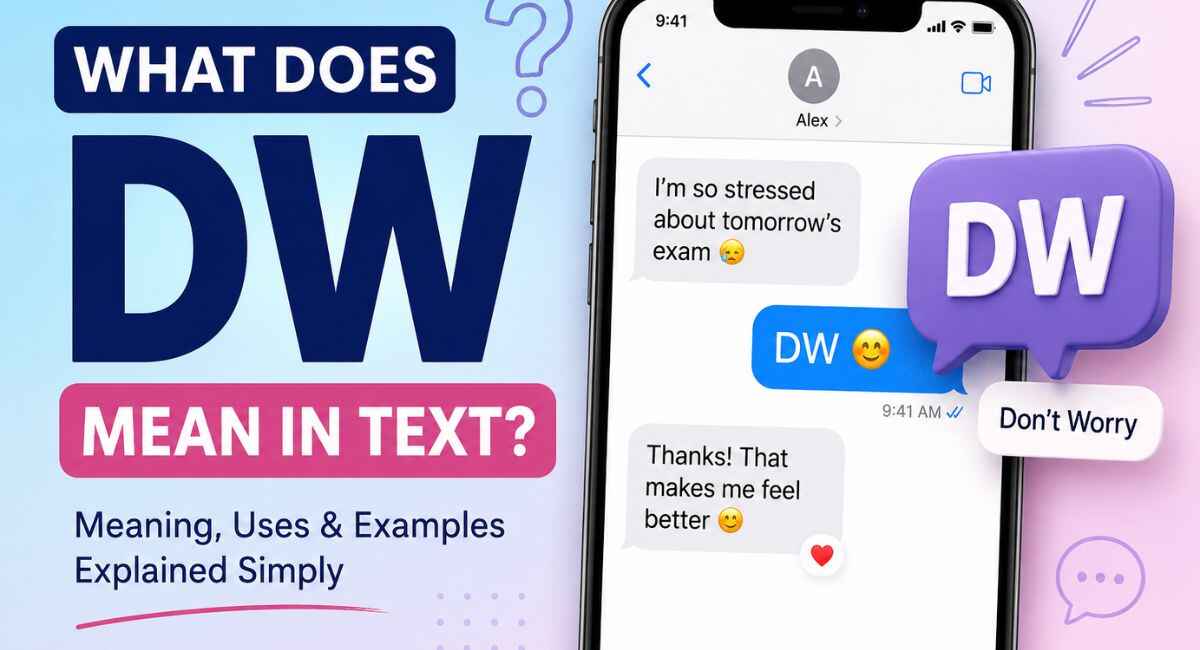

You’re scrolling through your messages and someone replies with just “dw” two lowercase letters, nothing else. Or maybe a friend texts “dw about it” after you spent three paragraphs apologizing for being five minutes late. What are they actually saying? Is it friendly? Dismissive? Somewhere in between?
This guide covers everything you need to know about the DW abbreviation, its primary meaning, all the alternate meanings people actually use, how it shows up across different platforms like Snapchat, Instagram, and WhatsApp, and exactly how to respond when someone sends it your way.
DW Meaning in Text: The Primary Definition
Short answer: In most text conversations, DW stands for “Don’t Worry.” It’s a quick, casual way to reassure someone, tell them to relax, or wave off an apology. That said, DW pops up in a few other contexts too — and knowing which meaning fits which situation can save you from some serious confusion.
When someone types “DW” in a text message or online chat, they almost always mean “Don’t Worry.” It’s one of those texting abbreviations that fits neatly into dozens of everyday situations: someone’s running late, they made a small mistake, they’re stressing over something minor, and you just want to ease the tension without writing a whole paragraph about it.
The beauty of DW is its versatility. It works as a standalone reply, it works mid-sentence, and it carries just enough warmth to read as reassuring without sounding dramatic. Think of it as the text-message equivalent of a calm hand on the shoulder.
Don’t WorryInternet SlangCasual TextingReassurance
Real Conversation Examples
Friend: Hey I’m so sorry I forgot to call you back 😬
You: dw!! It’s all good
Coworker: I might be a few minutes late to the call
You: DW, we haven’t started yet
Notice how in both cases, “DW” acts as an immediate calmer. It stops the other person from spiraling into an apology loop and signals that there’s genuinely no hard feelings. That’s why this particular piece of internet slang became so popular — it does a lot of emotional work in just two letters.
All the Different Meanings of DW in Texting
Here’s the thing about internet acronyms: they rarely stick to one meaning forever. DW is mostly “Don’t Worry,” but depending on who’s texting you and what context you’re in, it can mean something totally different. Here’s a full breakdown.
| Meaning | Context | Example |
| Don’t Worry | Most common — everyday texting, social media | “DW, I’ve got it handled” |
| Dear Wife | Parenting forums, family Facebook groups | “DW made the best lasagna tonight” |
| Doctor Who | Fandom communities, Reddit, Twitter/X | “Can’t believe the new DW season” |
| Disney World | Travel planning, family groups | “We’re taking the kids to DW next summer!” |
| Down for Whatever | Casual plans, Gen Z slang | “I’m DW — you pick the spot” |
| Doing Well | Health updates, check-ins | “She’s DW after the surgery” |
| Dead Weight | Gym culture, sports chats | “That player is straight DW on the team” |
Context is everything. If a parent is posting in a mom group and says “DW did the grocery run,” they clearly mean Dear Wife. If someone in a sci-fi Discord says “DW just announced a new companion,” that’s Doctor Who territory. But in a standard one-on-one text conversation? Ninety-nine times out of a hundred, DW means “Don’t Worry.”
How DW Is Used Across Different Platforms
Social media platforms each have their own conversational rhythm, and understanding where DW lives across those spaces makes it a lot easier to read correctly when you encounter it.
Snapchat
Used heavily in streaks and quick replies. “Dw I’ll send the streak” is a classic Snapchat response when someone’s worried about losing their streak count.
Shows up in DMs and comments. Someone apologizes for not liking your post fast enough — you drop “dw” and move on. Clean, frictionless communication.
TikTok
In the comments section, creators often reply “dw” to fans who express concern about them or their content. It feels personal even at scale.
Common in both individual and group chats. Group chats especially — someone forgets to buy something for the meetup and gets a chorus of “dw!!” from the group.
More common in Boomer and Millennial circles here, where it sometimes edges toward “Dear Wife” usage in family groups, but “Don’t Worry” still dominates.
SMS Texting
The original home of DW. Before apps dominated, this abbreviation was born in the era of limited character SMS messages and has stuck around ever since.
What Does DW Mean From a Guy or a Girl?
This is one of the most searched questions around this acronym, and honestly the answer is simpler than most people expect: DW means the same thing regardless of who sends it. It’s not a gendered expression. A guy saying “dw” is doing the exact same thing as a girl saying “dw” — offering a quick, casual form of reassurance.
That said, the tone behind DW can shift depending on the relationship and what came right before it. If someone you have feelings for says “dw about it” after you apologized for something, it could read as them brushing it off (fine, no big deal) or as genuine reassurance (I’m not upset, seriously). The two letters themselves don’t tell you which — the relationship context does.
“DW” is less about the sender’s gender and more about the emotional register of the conversation. Is the tone warm? Probably genuine reassurance. Is it flat or followed by silence? Might be worth a follow-up.
When DW Feels Dismissive vs. Supportive
Used well, DW is comforting. Used carelessly, it can feel like someone is shutting the conversation down. Here’s a quick way to tell the difference:
Supportive use: “DW, you did your best and that’s what matters” — the DW is an opener to something warmer.
Potentially dismissive use: “dw.” — full stop, nothing else, in response to something you clearly needed to talk about. That period at the end does a lot of emotional heavy lifting, and not in a great way.
Most of the time though? DW is exactly what it appears to be — a friendly shorthand that saves everyone the effort of typing “please don’t stress about this, it really isn’t a big deal.”
How to Respond When Someone Texts You DW
Knowing what DW means is one thing. Knowing what to actually say back is another. The good news: it doesn’t require overthinking. Here are some natural, human responses depending on the situation.
If You Were the One Who Apologized
They said “dw” in response to your apology — they’re telling you it’s fine. You can simply say “Thanks, appreciate it!” or “Okay, phew!” to close the loop without dragging it out. Or just send a relieved emoji. That works too.
If They Were Reassuring You About Something Else
Maybe you were anxious about a situation and they said “dw.” A good response acknowledges their reassurance: “Thank you, I needed to hear that” or “You always know what to say, haha.” It keeps the warmth going without making it weird.
If the DW Felt Abrupt
If the conversation felt like it got cut short with a “dw” and you still need to talk it through, it’s totally okay to say “I appreciate that, but I kind of want to talk about it for a minute?” Direct, honest, not dramatic.
DW vs. Similar Texting Abbreviations
DW sits in good company with a whole family of texting abbreviations that serve similar reassuring or conversational functions. Here’s how it compares to a few of them:
NP (No Problem) — While NP is more of a response to a thank-you, DW preemptively reassures. “NP” says “you’re welcome,” while “DW” says “don’t even worry about it.”
IKR (I Know, Right) — Agreement-based, very different function from DW’s reassurance role.
BRB (Be Right Back) — Purely logistical, telling someone you’re stepping away. No emotional weight at all.
TBH (To Be Honest) — Used to preface candid opinions. DW doesn’t ask for honesty, it offers comfort.
IDK (I Don’t Know) — Expresses uncertainty; DW does the opposite — it projects calm and certainty that things are fine.
Understanding where DW sits in the ecosystem of online abbreviations helps you use it naturally and know when another phrase might actually fit the moment better.
How Teenagers and Gen Z Actually Use DW
For Gen Z, texting isn’t just communication — it’s a form of self-expression, and the way they deploy DW reflects that. Younger users tend to layer DW with other slang, emoji, or context that gives it more flavor than a simple “don’t worry” would suggest.
You’ll see constructions like “dw abt it 😭” (don’t worry about it, I’m being dramatic), “dw bestie” (genuine reassurance between close friends), or even “dw dw dw” repeated for emphasis basically the text equivalent of waving both hands to say “please stop stressing.” In online spaces like TikTok comment sections and Discord servers, DW moves fast and feels effortless. It’s casual internet slang at its most efficient.
It’s also worth noting that Gen Z often uses punctuation to signal tone. “Dw” with no punctuation? Casual and warm. “Dw.” with a period? Could signal mild irritation or finality. “DW!!” with caps and exclamation points? Super enthusiastic reassurance. Two letters, many moods.
Is It Ever Appropriate to Use DW in Professional Settings?
Short answer: tread carefully. DW is fundamentally a casual internet language, and in most professional environments emails, formal Slack channels, client communication call for spelled-out phrases rather than text abbreviations. Telling a client “dw about the deadline” in a chat could read as flippant, even if you mean it warmly.
In a relaxed, startup-style team Slack channel where GIFs and memes are the norm? DW probably fits just fine. In a formal email thread with senior leadership? Stick to “Please don’t worry about that” or “That’s not a concern on our end.” The meaning is the same; the register is what changes.
Read the room or in this case, read the channel.
Frequently Asked Questions About DW
What does DW mean on Snapchat specifically?
On Snapchat, DW almost always means “Don’t Worry.” It’s commonly used when someone can’t keep up with streaks, replies late, or misses a snap. A quick “dw” assures the other person that there’s no drama. Snapchat’s fast-paced, story-driven format makes short abbreviations like DW perfect for its vibe.
Can DW mean something rude or negative?
In most contexts, DW is a positive or neutral expression. However, tone and context matter. If someone replies “dw.” (with a cold period) after a serious conversation, it might feel like they’re shutting you down. That’s more about delivery than the word itself DW on its own carries no inherently rude meaning.
What does DW stand for in family or parenting forums?
In parenting communities, Facebook mom groups, and family-oriented forums, DW often stands for “Dear Wife” or “Darling Wife.” You’ll also see DH (Dear Husband), DS (Dear Son), and DD (Dear Daughter) used in the same spaces. It’s a subculture of internet shorthand specific to family-forum communication.
How do you reply to someone who texts you DW?
If you were apologizing and they said “dw,” a simple “Thank you, that means a lot!” or even just “😅 okay good” works perfectly. If they were reassuring you about a worry, acknowledge it warmly: “You’re the best, thanks.” The response doesn’t need to be elaborate DW is a casual message and usually warrants a casual reply.
Is DW slang exclusive to young people?
Not at all. While Gen Z and Millennials made DW widespread in everyday texting culture, it’s used across all age groups on messaging apps. Older users pick it up naturally from family and friends, or through platforms like WhatsApp where it’s become completely normalized. It’s one of those internet abbreviations with genuinely broad demographic reach.
What’s the difference between DW and NP in texting?
“NP” (No Problem) typically responds to a thank-you someone says thanks, you say NP. “DW” (Don’t Worry) tends to respond to an apology or an expression of stress someone worries or apologizes, you say DW. They’re both reassuring, but they fit different conversational triggers. You can sometimes use them interchangeably, but they feel most natural in their specific lanes.
Final Thoughts
DW is one of the warmest little abbreviations in the texting world. Whether it’s a friend waving off your apology, a partner saying everything’s fine, or a creator reassuring their followers “Don’t Worry” carries real emotional weight in just two letters. Understanding it is less about memorizing a definition and more about reading the conversation around it.
Now that you know every meaning of DW, where it shows up, how to use it, and how to respond when someone sends it your way, you’re fully equipped to navigate it without a second thought. Go text with confidence and if you ever second-guess yourself, well, dw about it.