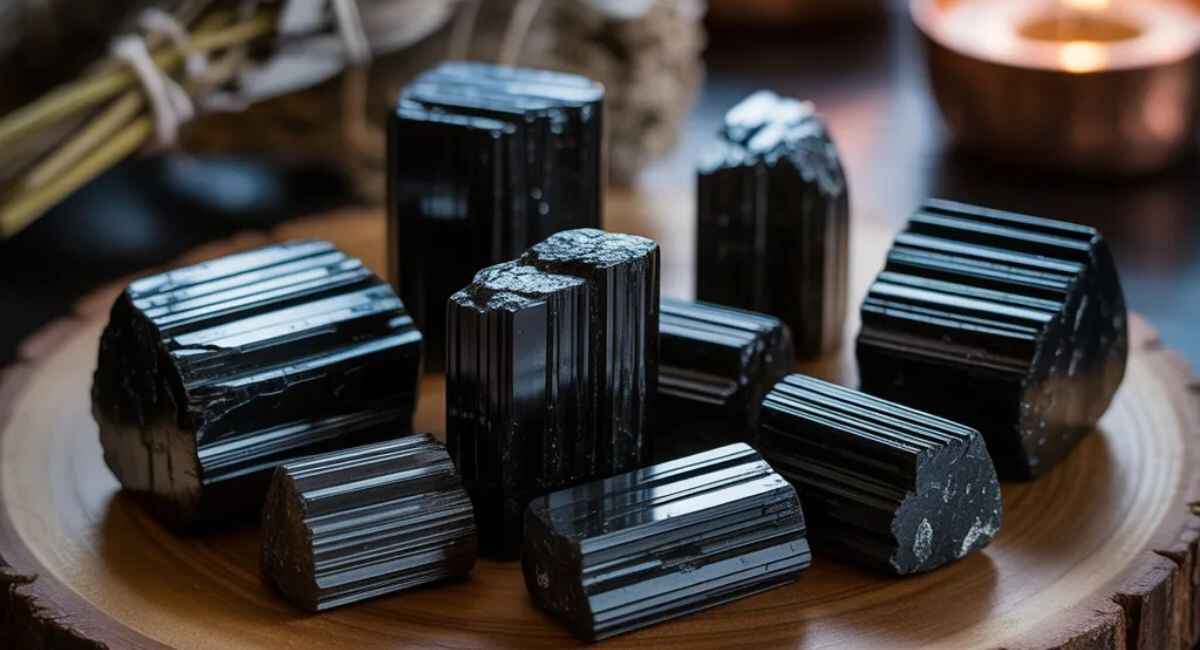

Some crystals sit quietly on a shelf, looking beautiful but doing nothing more. Black Tourmaline is not one of them.
Black Tourmaline is a deep black crystal that has been used for a long time across many cultures. It is also known as Schorl and is found in places like Brazil, Pakistan, Africa, and several other parts of the world. People often keep it close because they believe it helps them feel safe, calm, and more balanced in everyday life.
This stone is usually linked with protection and grounding. It is often worn as jewelry, placed in homes, or carried in a pocket. Many people say it helps reduce negative feelings and brings a sense of stability, especially during stressful times.
At the same time, Black Tourmaline is not just a spiritual symbol. It is a real mineral with a strong geological background, a long history, and interesting physical properties. Whether someone is drawn to it for its appearance, its meaning, or simple curiosity, it continues to be one of the most talked-about stones in the crystal world.
In simple words, Black Tourmaline is seen as a stone that helps you stay steady, clear-minded, and more protected from the heavy energy around you.
What Is Black Tourmaline? Geological Identity and Origins
Scientific Composition and Formation
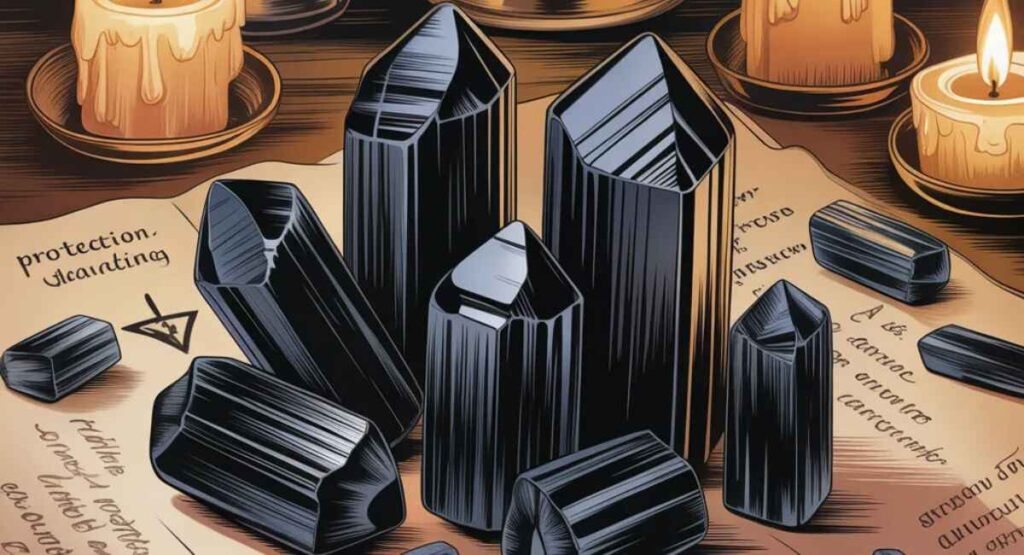
Black tourmaline is not just a name. Geologically, it is a specific member of the tourmaline mineral family known as schorl. It belongs to the boron silicate mineral group and forms within the trigonal crystal system, which gives it its characteristic elongated, striated appearance.
Schorl gets its deep black color from a relatively high iron content, which distinguishes it from other tourmaline varieties like rubellite (red) or indicolite (blue). Its hardness sits between 7 and 7.5 on the Mohs scale, making it durable enough for everyday jewelry wear while still being a natural mineral that deserves respectful handling.
The stone typically forms in pegmatite deposits, which are coarse-grained igneous rocks that cool slowly deep within the Earth. That slow formation process allows the crystals to grow large and develop their distinct striations and prismatic structure. You will often see raw black tourmaline with deep vertical lines running along the length of the crystal. Those are not damaged. That is just how it grows.
Interestingly, schorl is actually one of the most common tourmaline minerals found on Earth. Despite its abundance, its energy properties and visual presence have made it one of the most sought-after stones in both the collector and crystal healing communities.
Where Is It Found in the World?
Black tourmaline occurs on nearly every continent, which speaks to just how geologically widespread this mineral family is. The major sources include Brazil, which is historically one of the largest producers of gem-quality tourmaline. Pakistan and Afghanistan produce excellent specimens from the rich pegmatite fields of the Himalayan region. The United States, particularly in states like Maine and California, has historically yielded fine schorl crystals.
Africa is another significant source, with countries like Namibia, Mozambique, and Nigeria contributing to the global supply. Sri Lanka has produced tourmaline for centuries and is actually connected to the early European discovery of the mineral. India also has notable deposits, particularly in regions of Rajasthan and Bihar.
Historically, the name schorl has been traced back to Saxony, Germany, specifically to the Ore Mountains region, where miners encountered the black mineral for centuries before it was formally classified. The word itself likely predates formal mineralogy by hundreds of years.
Black Tourmaline Meaning and Symbolism
Historical and Cultural Significance
Long before crystal healing became a modern wellness trend, cultures around the world recognized black tourmaline as something worth carrying. African shamanic traditions used the stone as a protective talisman, believing it could guard against negative forces and earth-bound energies. In ancient India, the stone appeared in various spiritual and ceremonial contexts.
European alchemists and early natural philosophers noted tourmaline’s unusual pyroelectric and piezoelectric properties, meaning the crystal can generate an electrical charge when heated or subjected to mechanical pressure. This was not just metaphysical speculation. It is a documented physical property that made the stone genuinely fascinating even to scientists. Dutch traders in the 1700s reportedly used tourmaline to clear ash from their meerschaum pipes by exploiting this electrical property, calling the stone aschentrekker, or “ash puller.”
In many indigenous traditions globally, black stones were associated with the earth itself, with grounding, stability, and the protective qualities of deep soil and bedrock. Black tourmaline fit naturally into that symbolic framework.
Spiritual Meaning Across Traditions
In contemporary crystal healing and spiritual practice, black tourmaline meaning centers on three core ideas: protection, grounding, and purification.
The protection aspect is perhaps the most prominent. Practitioners describe the stone as creating an energetic shield around the aura, deflecting and transmuting negative energy rather than absorbing it passively. This is a meaningful distinction in crystal healing philosophy. Some stones are believed to absorb negative energy like a sponge and must be frequently cleansed. Black tourmaline, many practitioners argue, actively transforms that energy rather than simply holding it.
The grounding quality connects directly to the stone’s geological nature. It forms deep in the earth, carries iron, and has a weight and density that feels rooted. In spiritual terms, grounding refers to the practice of anchoring your energy to the present moment and the physical world, preventing that scattered, anxious, unmoored feeling that many people struggle with, especially in high-stress or digitally overloaded environments.
Purification rounds out the triad. Black tourmaline is associated with clearing the aura, the energetic field that many spiritual traditions describe as surrounding the physical body, and with removing energetic debris that accumulates through stress, conflict, and environmental exposure.
Black Tourmaline Healing Properties
Emotional and Mental Healing
This is where black tourmaline earns a lot of its modern reputation. As an emotional healing stone, it is frequently recommended for people dealing with anxiety, persistent negative thinking patterns, and the kind of low-grade stress that modern life tends to generate in abundance.
The logic, in crystal healing terms, is that the stone helps create energetic boundaries. When you have strong boundaries, both emotionally and energetically, you are less likely to absorb the stress, negativity, or emotional turbulence of people around you. Many highly sensitive people, often described in psychology as empaths, report finding black tourmaline particularly helpful for this reason.
Mental clarity is another frequently cited benefit. Some users describe a sense of greater focus and calm when working with the stone, less mental noise, and an improved ability to stay present. Whether this comes from the stone’s energy directly, from the mindfulness practice of intentionally working with crystals, or some combination of both is a matter of perspective. What seems consistent is the reported experience.
Emotional resilience and inner strength are also part of black tourmaline’s healing profile. It is sometimes called a stone of self-empowerment, supporting the kind of steady, grounded confidence that does not depend on external circumstances.
Physical Healing Support
Crystal healing does not replace medical care, and it is important to say that directly. Black tourmaline is not a treatment for any physical condition, and it should never be used as a substitute for proper medical attention.
That said, within the framework of complementary wellness, some practitioners associate black tourmaline with supporting the immune system, aiding detoxification processes, and promoting overall physical vitality. The stone’s grounding energy is thought to help regulate the nervous system, which in turn can support better sleep, reduced tension, and improved resilience to stress-related physical symptoms.
Its connection to the root chakra, which governs the physical body, survival instincts, and physical vitality, is part of why it shows up in discussions of physical wellbeing. A well-balanced root chakra is considered fundamental to physical health in many energy healing traditions, including those influenced by Ayurveda and Traditional Chinese Medicine.
Black Tourmaline Benefits for Protection and Grounding
Psychic Protection and Energy Shielding
Ask anyone who works with crystals professionally which stone they recommend first for protection, and black tourmaline is almost always near the top of the list. Its reputation as a psychic protection crystal is one of the most consistent themes in crystal healing literature across different traditions and time periods.
The idea is that the stone creates a protective energetic boundary or shield around the person carrying or wearing it. This boundary is believed to repel or deflect negative energy, harmful intentions from others, and disruptive environmental energies. Some practitioners also describe it as providing protection from psychic attack, a term used in various spiritual traditions to describe the negative impact of intense, focused negative thought directed at a person.
For more skeptically minded individuals, the benefit may be understood differently: carrying a physical object that you associate with protection and strength can have real psychological effects on confidence, boundary-setting, and stress resilience. In that sense, black tourmaline functions as a powerful symbolic anchor for intention.
Grounding Energy and Root Chakra Connection
Grounding is the practice of bringing scattered or anxious energy back down into a stable, present-centered state. It is a concept that appears in mindfulness, meditation, somatic therapy, and many spiritual traditions, and it describes something that many people genuinely struggle with, particularly in the overstimulated, always-on environment of modern life.
Black tourmaline is considered one of the premier grounding stones in the crystal kingdom. Its connection to the root chakra, known in Sanskrit as Muladhara, makes it particularly relevant for grounding work. The root chakra governs our sense of safety, stability, physical connection to the earth, and basic survival instincts. When this energy center is out of balance, people often experience anxiety, restlessness, dissociation, financial worry, and difficulty feeling safe in their own bodies.
Working with black tourmaline near the root chakra, either by placing it at the base of the spine during meditation, wearing it as a bracelet or anklet, or simply carrying it in a pocket, is a common practice for supporting chakra alignment and grounding energy.
Black Tourmaline and EMF Protection
This is one of the more modern applications associated with black tourmaline, and it deserves honest treatment.
The claim is that black tourmaline can protect against electromagnetic field (EMF) radiation emitted by cell phones, laptops, Wi-Fi routers, and other electronic devices. Many people place pieces of black tourmaline near their computers or carry the stone on their bodies for this reason.
Here is the nuanced reality. Black tourmaline does have genuine piezoelectric and pyroelectric properties, meaning it generates small electrical charges under certain conditions. This is a real, measurable physical phenomenon. However, peer-reviewed scientific evidence specifically demonstrating that the stone blocks or neutralizes harmful EMF radiation in a meaningful way does not currently exist. The scientific consensus on whether typical everyday EMF exposure causes significant biological harm is itself still an active area of discussion.
What is fair to say is that many people report feeling better, less fatigued, and more focused when using black tourmaline near electronic devices. Whether that comes from direct electromagnetic effects, the stone’s grounding influence on the nervous system, or the power of mindful intention is an open question. If the practice supports your wellbeing and peace of mind, it is a reasonable choice. Just pair it with evidence-based approaches to screen time and digital wellness.
How to Use Black Tourmaline in Daily Life
Wearing It as Jewelry
One of the most popular and practical ways to work with black tourmaline is through jewelry. Black tourmaline bracelets are particularly common, often made with tumbled stones or polished beads. Wearing the stone keeps its energy in consistent contact with your body throughout the day.
Many practitioners recommend wearing black tourmaline on the left wrist to receive its protective energy, though this is a matter of personal preference and tradition. Pendants, rings, and earrings are also available. The key is choosing pieces where the stone has genuine contact with your skin rather than being completely encased in resin or thick metal settings, which some believe reduces the energetic connection.
Meditation and Crystal Grids
For meditation practice, black tourmaline is an excellent grounding tool. Holding a piece in each hand during seated meditation is a simple technique that many find helps anchor the mind and prevent that tendency to drift into anxious thought loops. You can also place a piece at the base of your spine while lying down in a body scan meditation, particularly if you are working with root chakra healing.
Crystal grids are another creative application. A protection grid typically involves placing black tourmaline at the corners or perimeter of a space, often paired with other stones like selenite for cleansing, clear quartz for amplification, or obsidian for additional protective energy. The visual geometry of the grid is itself a focus for intention-setting.
Home and Office Placement
Placing black tourmaline near the entrances of your home is a traditional practice in crystal protection work. The idea is that the stone creates an energetic boundary at the threshold, filtering out negative energy before it enters your living space. Many people place a piece near the front door, either in a bowl with other protective stones or tucked into a corner nearby.
For the office environment, keeping a piece on your desk is popular for its combination of grounding and EMF-adjacent protective qualities. It serves as a visual reminder to stay grounded and boundaried in professional interactions, which has real practical value regardless of your views on energy work.
Feng Shui Applications
In feng shui practice, black tourmaline aligns with the water element’s purifying qualities and the earth element’s stabilizing energy. It is often placed in the north area of a home or room to support career energy and life path clarity, or near the main entrance to protect the home’s chi from stagnation or negative influences from outside.
The stone’s dark color connects it to the concept of yin energy in Chinese metaphysics, grounding, introspective, and restorative. It pairs well with other feng shui protective tools like black obsidian spheres or mirrors used to deflect unfavorable energy.
How to Cleanse and Recharge Black Tourmaline
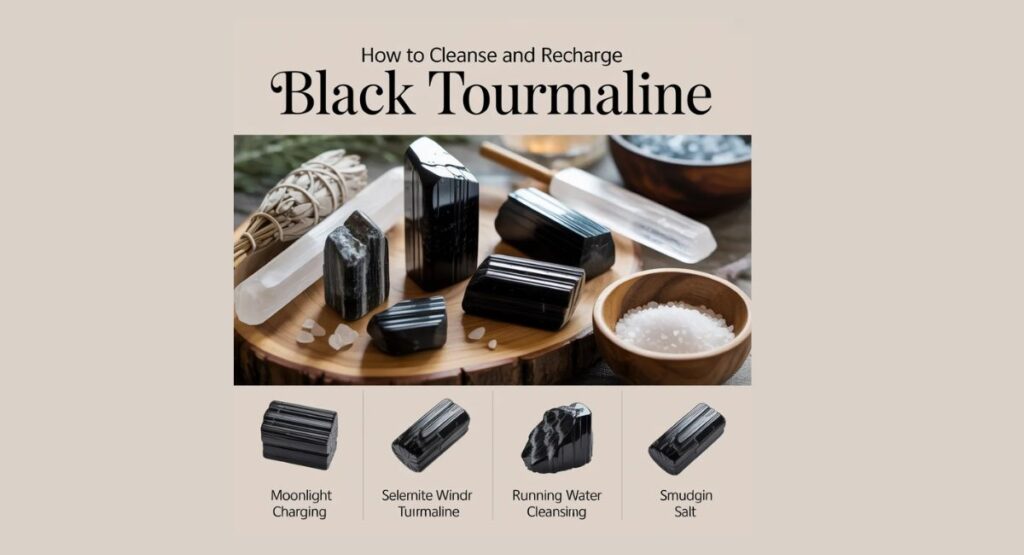
Since black tourmaline is widely understood to work actively with energy, either transmuting it or shielding against it, regular cleansing is considered important maintenance in crystal healing practice.
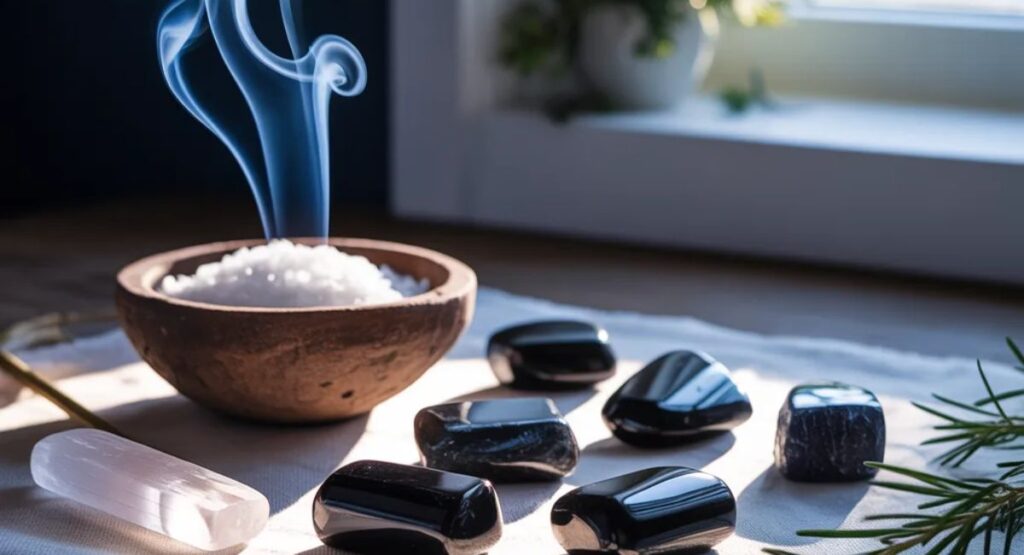
Several methods work well with this stone. Smudging with sage, palo santo, or cedar smoke is one of the most common approaches. Pass the stone through the smoke while setting a clear intention for it to be cleansed and reset. This is gentle on the stone and suitable for regular use.
Running water is another effective method. Briefly holding the stone under cool running water while visualizing any absorbed or accumulated energy being washed away and returned to the earth works well. Since black tourmaline is a 7 to 7.5 on the Mohs scale, brief water exposure will not damage it, but avoid prolonged soaking.
Burying the stone in the earth for 24 to 48 hours is considered one of the most thorough cleansing methods, particularly fitting given the stone’s deep connection to earth energy. Just mark where you buried it.
Moonlight cleansing, leaving the stone outside or on a windowsill under the full moon overnight, is a favorite low-effort method that many crystal workers use for all their stones simultaneously.
For recharging specifically, placing black tourmaline on a selenite charging plate, in sunlight for a brief period, or near a cluster of clear quartz is commonly practiced. The stone responds particularly well to being returned to the earth or to natural outdoor environments.
Frequently Asked Questions
What is the main spiritual meaning of black tourmaline?
Black tourmaline is primarily understood as a stone of protection, grounding, and purification. Its core spiritual meaning centers on creating a strong energetic boundary around the aura, shielding against negative energy, and anchoring the spirit firmly to the present moment and the physical world. It is one of the most widely recommended stones for anyone beginning a crystal healing practice precisely because its protective qualities are considered foundational.
Is black tourmaline good for anxiety?
Many practitioners and users report significant benefits for anxiety when working with black tourmaline. The stone’s grounding energy is particularly relevant for anxiety, which often involves a disconnection from the present moment and an overactivation of the nervous system. By supporting root chakra balance and providing a physical anchor through touch and intention, black tourmaline can be a useful complementary tool alongside proper mental health support. It is not a replacement for therapy or medical care, but as part of a broader wellness practice, many people find it genuinely helpful.
How do I know if my black tourmaline is real?
Authentic black tourmaline typically has visible vertical striations along the surface of raw pieces. It is naturally opaque and has a slightly rough, uneven texture in raw form. Tumbled pieces will be smoother but should still show some depth in the black coloring rather than a flat, uniform appearance. Genuine schorl is heavier than glass or plastic imitations and will feel cool to the touch initially. If buying from a reputable crystal supplier, ask about the sourcing and whether the stone is naturally mined schorl or a dyed imitation.
Can I wear black tourmaline every day?
Yes, black tourmaline is one of the most suitable crystals for everyday wear. Its Mohs hardness of 7 to 7.5 makes it durable enough for jewelry use, and its protective and grounding properties are considered beneficial for daily life in most circumstances. Regular cleansing is recommended to keep it working effectively, especially if you are wearing it consistently in high-stress or energetically demanding environments.
What chakra is black tourmaline associated with?
Black tourmaline is primarily associated with the root chakra, known in Sanskrit as Muladhara. This energy center sits at the base of the spine and governs physical safety, stability, survival instincts, and our sense of being grounded in the physical world. Working with black tourmaline is considered supportive of root chakra balance and alignment, which in turn supports overall energetic stability and physical vitality.
How should I use black tourmaline for the first time?
If you are new to working with black tourmaline, start simply. Hold the stone in your hands, take a few slow breaths, and set a clear intention for what you want the stone to support, whether that is protection, grounding, or emotional calm. Carry it in your pocket for a week and notice how you feel. From there, you can explore wearing it as jewelry, incorporating it into meditation, or placing it in your home. There is no strict protocol. Intention and consistency matter more than elaborate ritual.
Final Thoughts
Black tourmaline is one of those rare stones that earns its reputation. Backed by a genuine and fascinating geological identity as schorl, one of the earth’s most common yet compelling silicate minerals, and supported by centuries of cross-cultural use as a protection and grounding tool, it brings something real to the table regardless of the lens through which you approach it.
Whether you are drawn to it for its spiritual properties, its role as a root chakra crystal, its practical application in reducing the mental noise of an overwhelming modern environment, or simply because it feels good to hold something solid and grounding in your hand, black tourmaline meets you where you are. Start with one piece, carry it with intention, and pay attention to what shifts. Sometimes the oldest tools turn out to be the most reliable ones.