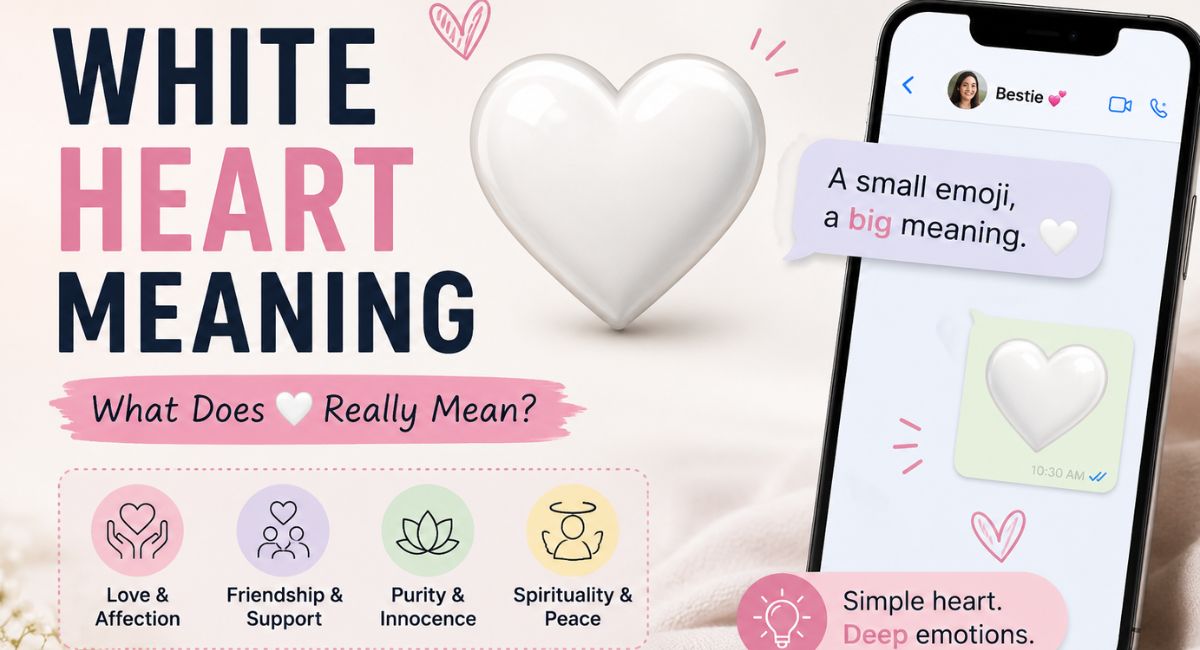

Think about the last time someone sent you a white heart in a message. Did you pause for a second, trying to figure out exactly what they meant? You’re not alone. The 🤍 white heart emoji is quietly one of the most nuanced symbols in modern digital communication sitting somewhere between sincere affection, cool aesthetic, gentle support, and soft romance.
Unlike the red heart, which everyone immediately understands as intense love, the white heart leaves a little more room for interpretation. And that ambiguity is actually part of its charm. This guide covers every angle from what the white heart means in texting and relationships to how its meaning shifts across Instagram, TikTok, Snapchat, and WhatsApp.
What Is the White Heart Emoji?
The white heart emoji 🤍 is exactly what it sounds like: a heart shape rendered entirely in white. It was introduced as part of Unicode 12.0 and officially added to the Emoji 12.0 standard in 2019, making it one of the newer entries in the heart emoji family. Before that, if you wanted a heart that wasn’t red, yellow, blue, or black, you were out of luck.
The Unicode name for it is simply “White Heart,” and across platforms Apple, Android, Samsung, WhatsApp, Twitter/X — it renders in varying shades of white or very light gray. On some systems it has a faint outline; on others it appears as a solid, clean white shape. The visual is minimal by design, and that minimalism directly informs its emotional meaning.
Quick Facts: 🤍 White Heart Emoji
- Unicode version: Unicode 12.0 (released March 2019)
- Emoji version: Emoji 12.0 (released 2019)
- Unicode code point: U+1F90D
- Also called: White heart, clean heart, pure heart, soft heart
- Related emojis: 🖤 ❤️ 💛 💙 💜 🩶 🩷
The Core Meanings of 🤍
Here’s the thing about the white heart: it doesn’t carry one single meaning. Context shapes it heavily. But there are a handful of emotional themes that show up consistently across how people actually use it in real conversations.
Purity and Sincerity
White has symbolized purity and clarity across cultures for centuries. That same symbolic weight carries over into the emoji. When someone sends you a 🤍, they’re often expressing something genuine a love or affection that feels untainted and straightforward. There’s nothing dramatic about the white heart. It’s clean and honest, which is exactly why many people reach for it when they want to express a heartfelt sentiment without any romantic intensity.
Platonic Love and Deep Friendship
This is probably the most common use. The white heart has become a go-to emoji for expressing deep platonic affection, the kind of care you have for a best friend, a sibling, or a close mentor. It says “I love you” in a way that feels warm but not romantically charged. You’d text it to your childhood best friend, your college roommate, or the colleague who always has your back. It’s sincere without being heavy.
Calm and Gentle Affection
Unlike the red heart’s intensity or the black heart’s edge, the white heart carries a distinctly soft emotional tone. It feels quiet and calming. People often use it in moments of emotional support when a friend is going through something hard, or when you want to say “I’m here for you” without adding noise to a sensitive situation. It’s compassionate without being overwhelming.
Aesthetic and Minimalism
Social media aesthetics play a significant role here. White is a core color in the minimalist, clean-aesthetic visual culture that exploded on Instagram and Pinterest. The white heart fits seamlessly into soft, neutral, monochrome content; it visually matches white-themed feeds, light photography, and the kind of understated digital aesthetic that many creators deliberately cultivate. Influencers and aesthetic accounts use it in captions not just for emotional meaning, but as a visual and tonal choice.
Remembrance and Tribute
In more somber contexts, the white heart is sometimes used in memorial or tribute posts. White is widely associated with peace and the spiritual in many cultures, and the white heart carries that resonance online too. You’ll see it in posts remembering someone who has passed, alongside words of condolence, or in anniversary tributes. In these situations it expresses a quiet, lasting love — the kind that doesn’t need bright color to be felt.
“The white heart doesn’t shout. It whispers and sometimes that’s more powerful than anything else you could say.”
Spiritual and Heavenly Meaning
Some users reach for the white heart emoji in specifically spiritual contexts. White’s association with angels, peace, and divine love makes it a natural fit for expressing faith-based affection or spiritual connection. On platforms like Instagram and Twitter, faith communities sometimes use it in place of more traditional religious symbols to convey a sense of heavenly or divine love.
What Does RS Mean in Text Messaging? Full Slang Guide for 2026
White Heart Meaning by Context and Relationship
The same emoji can carry very different weight depending on who sends it and in what context. Here’s how the white heart shifts meaning across different relationship dynamics.
White Heart Meaning from a Girl
When a girl sends a white heart, it most often signals genuine warmth and care but typically at a lower intensity than a red heart. In a friendship context, it’s a declaration of deep, platonic closeness. Between acquaintances, it might simply mean appreciation or positivity. If there’s a romantic context already in the conversation, it can carry a soft, tender note — an affection that’s real but gentle rather than passionate. Reading the surrounding messages is key here.
White Heart Meaning from a Guy
Guys tend to use the white heart more sparingly than other heart colors, and when they do, it usually carries genuine meaning. From a guy, it often signals sincere appreciation, quiet affection, or emotional support. It might appear at the end of a supportive message to a friend going through something difficult, or as a soft gesture in a romantic conversation that hasn’t fully defined itself yet. It rarely comes across as casual or throwaway; it tends to feel intentional.
White Heart in Romantic Conversations
In a budding relationship or a flirtatious exchange, the white heart can function as a soft romantic signal. It’s more subtle than a red heart but more personal than a thumbs-up. If someone who’s interested in you sends a 🤍, they might be testing the emotional waters — expressing that they care without committing to full-on romantic declaration. It has a “you matter to me” quality that leaves room for the relationship to define itself.
White Heart for Emotional Support
This is one of the most emotionally resonant uses. When someone shares difficult news or opens up about a struggle, a white heart response says: I hear you, I care, I’m here. It’s non-intrusive. It doesn’t try to fix anything. It simply offers presence and warmth, which is sometimes exactly what a person needs. The white heart in this context acts as a quiet symbol of solidarity.
White Heart Meaning on Different Platforms
Digital culture isn’t monolithic. The same emoji reads differently depending on where it appears, which audience is using it, and what the surrounding content looks like. Here’s a breakdown by platform.
📸
Aesthetic captions, minimalist feeds, friendship appreciation posts, and creator tributes.
🎵
TikTok
Soft comments, supportive reactions to emotional videos, aesthetic content tagging.
👻
Snapchat
Warm streak closers, close friend messages, gentle affection in private chats.
💬
Personal chats, emotional support, sending love without the intensity of red.
White Heart Meaning on Instagram
Instagram is where the white heart’s aesthetic dimension really shines. The platform’s highly visual culture, particularly the white-and-neutral aesthetic that became dominant through the mid-2020s, made the white heart a natural fit. Creators use it in captions for lifestyle content, gratitude posts, and friendship shoutouts. In comments, it often appears as a gentle, appreciative response — one that fits the tone of soft, aspirational content without feeling over-the-top.
White Heart Meaning on TikTok
TikTok’s comment sections are their own ecosystem. The white heart there tends to appear in two main contexts: emotional support under vulnerable or confessional videos (“you’re not alone 🤍”) and as an aesthetic marker on content that leans into peaceful, calm, or soft visuals. It’s also increasingly common in the mental health content space on TikTok, where creators and followers use it to signal care and solidarity.
White Heart Meaning on Snapchat
On Snapchat, where communication is more personal and ephemeral, the white heart tends to appear in close-friend chats and streaks. It carries genuine warmth in that context — it’s the kind of emoji you’d send to someone you genuinely care about, at the end of a real conversation. Unlike more casual platforms, Snapchat messages tend to be more intimate, so the white heart there often does mean something sincere.
White Heart Meaning on WhatsApp
WhatsApp, being a primary messaging platform for personal relationships in many parts of the world, sees the white heart used in much the same way you’d use it in any close personal conversation. It’s common in family group chats as a sign of love, in friend messages as an expression of appreciation, and in more private chats as a soft romantic or affectionate gesture. The meaning tracks closely with the real-world relationship between the sender and receiver.
White Heart vs. Other Heart Emojis
Heart emojis are a whole language. To really understand what the white heart means, it helps to see where it sits relative to its colorful counterparts. Each heart carries its own emotional register.
| Emoji | Name | Primary Meaning | Emotional Tone |
| ❤️ | Red Heart | Romantic love, deep passion | Intense, warm, direct |
| 🤍 | White Heart | Pure love, friendship, calm affection | Soft, sincere, understated |
| 🖤 | Black Heart | Dark humor, edgy affection, grief | Cool, ironic, or sorrowful |
| 💛 | Yellow Heart | Friendship, happiness, positivity | Cheerful, warm, casual |
| 💙 | Blue Heart | Trust, loyalty, calm | Steady, reliable, stable |
| 💜 | Purple Heart | Compassion, spirituality, fandom | Thoughtful, empathetic |
| 🩶 | Gray Heart | Neutrality, sadness, uncertainty | Subdued, reflective, quiet |
The most telling comparison is between the white heart and the red heart. A red heart leaves no ambiguity — it’s romantic love, full stop. The white heart occupies more nuanced territory. It can mean romantic affection in the right context, but it just as easily means deep friendship, sincere appreciation, or gentle emotional support. That flexibility is what makes it so widely used across different kinds of relationships.
Compared to the black heart, the white heart sits at the opposite end of the emotional spectrum. Where the black heart often signals dark humor, ironic detachment, or even grief, the white heart leans toward lightness — pure, uncomplicated care. Both can be used in memorial posts, but they carry different textures of grief: the black heart darker and heavier, the white heart more peaceful and resigned.
How to Use the White Heart Emoji Correctly
There’s no single rulebook for emoji use but there are situations where a white heart fits naturally and others where it might send the wrong signal. Here’s a practical guide.
When the White Heart Works Perfectly
You’re texting a close friend you haven’t seen in months and want to close with something warm but not dramatic. A white heart does that job beautifully. You’re posting an Instagram caption about a memory that means a lot to you, or sharing a minimalist photo you love the white heart fits the tone. You’re responding to a friend’s difficult news and want to show care without adding any noise. You’re celebrating a quiet milestone or expressing gratitude that doesn’t need a parade. These are all moments where 🤍 lands with exactly the right weight.
When to Think Twice
If you’re trying to express intense romantic love, the white heart might underdeliver. A red heart is almost always the clearer choice in that case. Similarly, if you’re in a brand-new conversation with someone you don’t know well, leading with a white heart could feel slightly intimate or confusing — better to build to it. Context is everything. The white heart works when there’s already a warm emotional baseline to the relationship or the content.
White Heart in Aesthetic Captions
On platforms like Instagram and TikTok, the white heart’s aesthetic function is just as legitimate as its emotional one. Using it at the end of a caption tied to neutral, minimal, or white-themed content isn’t meaningless; it’s a form of visual and tonal consistency. It signals that you care about the mood your content creates. Many creators use it deliberately for exactly this reason, and audiences read it accurately as an aesthetic choice rather than a specific emotional statement.
How to Respond to a White Heart
- In a friendship context: match the energy — send one back, or respond warmly in words.
- In a romantic context: mirror it if you feel the same; escalate to ❤️ if you want to signal more.
- In a support context: acknowledge it simply — “thank you 🤍” works perfectly well.
- In an aesthetic post comment: a return 🤍 or a simple appreciation is usually right.
Frequently Asked Questions About the White Heart Emoji
Is the white heart emoji romantic?
It can be, but it isn’t inherently romantic. The white heart occupies a middle ground: it can signal soft romantic interest in the right context, but it’s more often used to express sincere friendship, platonic affection, or emotional support. If someone you’re dating sends you a white heart, it’s almost certainly affectionate. If a friend sends it, it’s more likely an expression of warmth and care than a romantic signal. Context and relationship history matter a lot here.
What is the difference between a white heart and a red heart?
The red heart ❤️ almost always signals romantic love or deep, passionate affection. It’s direct and leaves little room for interpretation. The white heart 🤍 is far more versatile it can mean friendship, pure love, calm affection, emotional support, aesthetic preference, or spiritual connection. The red heart is an exclamation; the white heart is more like a whisper. They’re not interchangeable, though both express genuine positive feelings.
What does the white heart mean from a guy?
When a guy uses the white heart emoji, it typically signals something genuine; he doesn’t tend to use it casually. From a male friend, it often means sincere appreciation or a moment of emotional solidarity. From a guy who’s romantically interested, it can be a soft, deliberate way of expressing affection without going full red heart. Either way, if he took the time to send a 🤍, it usually means he genuinely cares in some way about the person or the moment.
Why do people use white hearts on TikTok?
On TikTok, the white heart emoji shows up for two main reasons. First, as an expression of emotional support in response to vulnerable or heartfelt content, viewers use it to say “I see you, I care.” Second, as an aesthetic marker on soft, minimal, or calming content. TikTok’s algorithm and community culture have given the white heart strong associations with gentleness, sincerity, and quiet beauty, which makes it one of the more emotionally loaded emoji in comment sections there.
Does the white heart mean purity or something spiritual?
Yes, in some contexts. White’s long-standing association with purity, peace, and the spiritual carries into the white heart emoji. In faith communities, memorial posts, or content that touches on themes of healing and peace, the white heart is often chosen deliberately for these connotations. It can represent a love that’s untainted, or an affection that exists beyond the material or romantic something closer to grace or compassion. That said, spiritual meaning isn’t the most common interpretation in everyday casual texting.
When should you use a white heart instead of other heart emojis?
Reach for the white heart when you want to express genuine warmth without the intensity of a red heart. It’s ideal for: messaging a close friend you care about deeply, showing emotional support in a quiet and non-dramatic way, creating social media content with a minimal or white aesthetic, expressing appreciation or gratitude, or paying tribute to someone. If the situation calls for something soft, sincere, and understated, the white heart is usually the right call.
Final Thoughts: The Quiet Power of 🤍
The white heart doesn’t demand attention. It doesn’t carry the obvious weight of a red heart or the ironic coolness of a black one. Instead, it does something quieter and, in many ways, more versatile. It expresses pure love, sincere friendship, soft affection, and gentle support all at once, shifting meaning naturally based on context and relationship.
Whether you see it in an Instagram caption, a late-night text from a best friend, a TikTok comment section, or a memorial post, it’s almost always saying some version of the same thing: I care about this. I care about you.
Understanding the white heart means understanding how modern emotional communication works; it’s layered, context-dependent, and often deliberately subtle. And there’s real value in that subtlety. Not every feeling needs to be shouted. Sometimes a small white heart, placed just right, says more than a paragraph ever could.