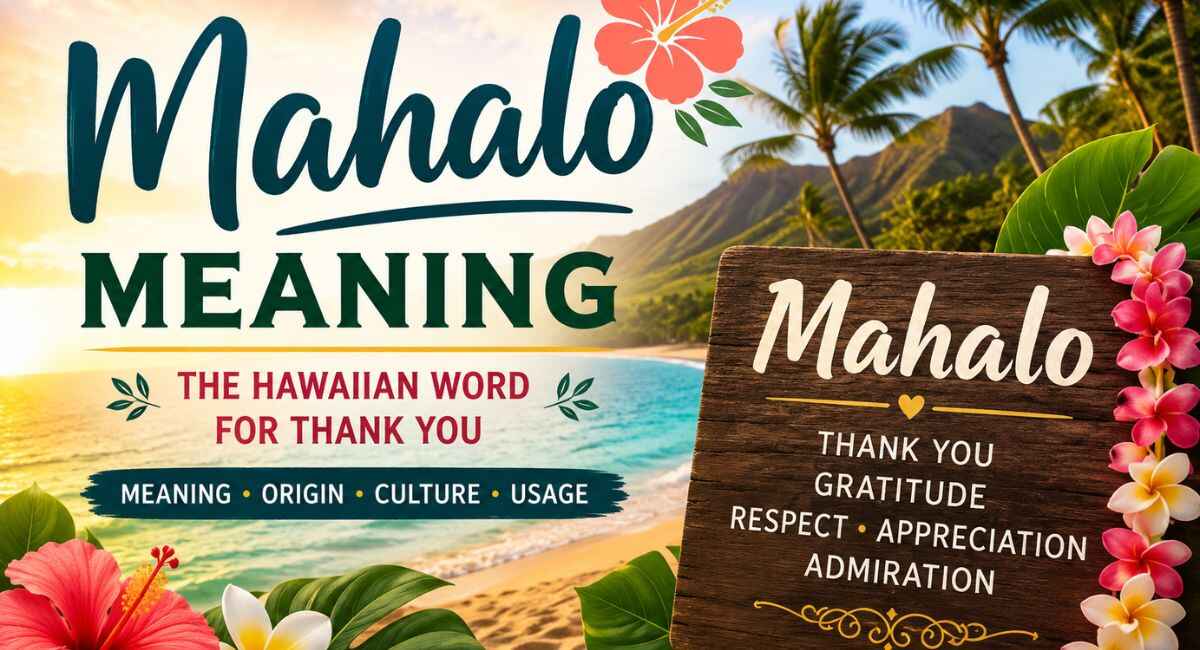

“Mahalo” is a Hawaiian word that means “thank you.” It is used every day in Hawaii when people want to show gratitude or appreciate someone’s help or kindness. You will hear it in shops, hotels, restaurants, and many other places across the islands.
But mahalo is more than just a simple thank you. In Hawaiian culture, it carries respect and a real feeling of appreciation. When someone says mahalo, they are not only thanking the person but also recognizing their kindness in a meaningful way.
In this article, we will look at what mahalo means, where it comes from, and how people use it in daily life in Hawaii.
What Does Mahalo Actually Mean? The True Definition
At its most basic, mahalo translates to “thank you” in Hawaiian. But that translation, while technically accurate, is like calling the ocean “a large puddle.” It misses the depth entirely.
The Literal Linguistic Breakdown
Hawaiian is a Polynesian language, and like all Polynesian languages, its words are built from layered root meanings. When linguists and Hawaiian language scholars break down mahalo, they find something remarkable:
- Ma means “in” or “within”
- Ha refers to the divine breath, the life force the same breath that, in Hawaiian tradition, connects all living things
- Alo means “presence,” “face,” or “front”
Put it together and mahalo becomes something like “in the presence of the divine breath” or “within the presence of life.” That’s not just gratitude, that’s a spiritual acknowledgment of the sacredness of the moment and the person in front of you.
The Hawaiian Dictionary compiled by scholars Mary Kawena Pukui and Samuel H. Elbert, the definitive reference for ʻōlelo Hawaiʻi (the Hawaiian language), defines mahalo as expressing admiration, praise, esteem, and gratitude. It is simultaneously a feeling, an expression, and an act of recognition.
Mahalo vs. Mahalo Nui Loa
You’ll often hear the extended phrase mahalo nui loa, which layers on even more warmth. Here’s what each component adds:
- Nui means “big,” “great,” or “many”
- Loa means “very much,” “long,” or “far”
So mahalo nui loa translates roughly to “thank you very much” but with that same spiritual undertone magnified. It’s the version you use when a simple nod won’t cut it. Think of it as the difference between a handshake and a full embrace.
Shibari Meaning: Beginner Guide To Japanese Rope Bondage Art
The Pronunciation of Mahalo: Say It Right
If you’re heading to Hawaii or just want to use this word with genuine respect, pronunciation matters. Saying it wrong isn’t offensive, but saying it right is a small act of cultural appreciation.
How to Pronounce Mahalo
mah-HAH-loh
Break it down like this:
- Ma — sounds like “mah,” as in “ma” (mother)
- Ha — rhymes with “ha” as in laughter, with a soft open vowel
- lo — sounds like “loh,” with a long O
Every vowel in Hawaiian is pronounced separately and clearly. There are no silent letters, no blended vowels that swallow each other. The Hawaiian alphabet has only 13 letters five vowels (a, e, i, o, u) and eight consonants (h, k, l, m, n, p, w, and the ʻokina glottal stop) which gives the language its flowing, musical quality.
A common mistake among tourists is rushing through the word or softening the middle syllable. Slow it down. Let each vowel breathe.
Mahalo in Hawaiian Culture: It’s About the Aloha Spirit
To truly grasp why mahalo carries such weight, you need to understand the cultural soil it grows in. Hawaiian culture isn’t just a set of customs, it’s a complete philosophy about how human beings relate to each other, to the land, and to the unseen forces that run through all living things.
The Aloha Spirit and What It Has to Do With Mahalo
You’ve heard of the aloha spirit; it’s so central to Hawaiian identity that it’s actually codified in Hawaii state law (Hawaii Revised Statutes Section 5-7.5). But aloha isn’t just a greeting, just as mahalo isn’t just a farewell expression of thanks.
Aloha, at its root, shares that same as the breath, the life force. Aloha literally means something like “the presence of breath” or “love shared in the breath of life.” Saying aloha and saying mahalo are, in a sense, two sides of the same spiritual coin. Aloha is what you offer; mahalo is what you return.
This is where the concept of reciprocity becomes important. Hawaiian culture has always centered on cycles: the cycle of the ocean, the seasons, the food supply, and yes, human kindness. Mahalo isn’t just a passive “thanks.” It’s an active acknowledgment that something was given, that it was received with awareness, and that the cycle of generosity continues.
Mahalo and the Concept of Kuleana
One of the most important values in Hawaiian culture is kuleana, which refers to personal responsibility, privilege, and the accountability that comes with any gift or role. When you say mahalo, you’re not just saying “I got it, thanks.” You’re implicitly saying, “I recognize what was given, and I take on the responsibility of honoring it.”
This is why hearing mahalo from a Native Hawaiian elder or from someone deeply rooted in the culture feels different from hearing a casual “thanks.” It lands differently because it means something different: a full acknowledgment, not just a social nicety.
Gratitude as a Core Hawaiian Value
In Hawaiian tradition, gratitude isn’t a feeling you express after something good happens to you. It’s a baseline orientation toward the world, a default state of appreciation for the land (ʻāina), the ancestors (kupuna), the community (ohana), and the forces of nature that sustain life.
This philosophical grounding is part of what scholars call pono, often translated as “righteousness” or “balance.” Living pono means existing in harmony with yourself, your relationships, your environment. Mahalo is a daily practice of pono: a conscious, repeated act of recognizing the goodness around you.
Hawaiian Words Every Visitor Should Know (And Mahalo Is Just the Start)
If you’re visiting Hawaii, learning a handful of key Hawaiian phrases isn’t just useful, it’s a sign of respect. Here are a few words that travel naturally alongside mahalo:
Aloha
Probably the most internationally recognized Hawaiian word, aloha serves as hello, goodbye, and a declaration of love and peace. It sets the tone for every interaction.
Ohana
Ohana means family, but not just blood relatives. In Hawaiian culture, ohana extends to chosen family, community, and anyone who shares deep bonds of care and responsibility.
Pono
This word describes a state of righteousness, balance, and correctness. “E ola pono” means “live righteously” , a common blessing.
Mana
Mana is spiritual power or authority, the invisible force that flows through people, objects, and places. Certain locations in Hawaii are considered to hold tremendous mana, and treating them with reverence is expected.
Kamaaina
Literally meaning “child of the land,” kamaaina refers to longtime residents of Hawaii, often contrasted with tourists. You’ll see it used in “kamaaina discounts” price reductions for locals at various attractions and hotels.
Mauka and Makai
These direction words replace “inland” (mauka) and “toward the sea” (makai) and are used constantly in everyday directions on the islands.
The Historical Roots of the Hawaiian Language
Hawaiian belongs to the Eastern Polynesian branch of the Austronesian language family, making it a linguistic cousin to Maori (New Zealand), Tahitian, and Samoan. The ancestors of the Hawaiian people were extraordinary Polynesian voyagers who navigated the Pacific using stars, ocean swells, and bird pattern feats of navigation that weren’t fully appreciated by Western science until the 20th century.
For much of the 19th and early 20th centuries, ʻōlelo Hawaiʻi (the Hawaiian language) was actively suppressed. Following the illegal annexation of Hawaii in 1898 and the establishment of an American-dominated school system, Hawaiian children were forbidden from speaking their native language in schools. By the mid-20th century, the number of native Hawaiian speakers had collapsed to just a few thousand.
Then came the Hawaiian Renaissance of the 1970s, a sweeping cultural revival that brought language, hula, traditional navigation, and Hawaiian arts back to the forefront of island life. Hawaiian language immersion schools called Pūnana Leo were established. Today, ʻōlelo Hawaiʻi is a recognized official language of the State of Hawaii alongside English, and the number of speakers is slowly but steadily growing.
Every time someone says mahalo with genuine understanding, they’re participating however small in that revival.
Common Ways Mahalo Is Used Today
In Everyday Conversation
“Mahalo” works exactly where you’d use “thank you” in English:
- Cashier hands you change: “Mahalo.”
- Someone holds the door: “Mahalo nui.”
- A host welcomes you to their home: “Mahalo for having me.”
On Signage and in Tourism
You’ll see mahalo on signs throughout the islands at parks, on public transportation, in hotels. It’s Hawaii’s warm, distinctly local alternative to “thank you” that signals you’ve arrived somewhere with its own culture and identity.
In Cultural Ceremonies and Performances
At traditional Hawaiian ceremonies, hula performances, and community gatherings, mahalo is used as a formal closing acknowledgement, a way to honor the audience, the ancestors, and the occasion itself.
In Music and Oral Tradition
Hawaiian music is rich with the word mahalo. From traditional mele (chants) to contemporary Hawaiian artists, expressing gratitude is a constant thread woven through the culture’s artistic life.
Why Mahalo Matters Beyond Hawaii
In a time when many people feel the world has become more transactional and less connected, the philosophy embedded in mahalo offers something genuinely valuable. The idea that gratitude is not just a response but a way of seeing that every interaction carries the divine breath of life is a reminder that even the smallest exchanges can be meaningful.
Psychologists have documented extensively that practicing gratitude improves well-being, strengthens relationships, and even has measurable physical health benefits. But what Hawaiian culture understood long before the research arrived is that gratitude isn’t just a personal practice it’s a communal one. When you say mahalo with intention, you’re reinforcing the bond between yourself and another person. You’re saying: I see you, what you did matters, and the circle of care continues.
That’s a philosophy worth borrowing, whatever island you happen to live on.
Frequently Asked Questions About Mahalo
What does mahalo mean in Hawaiian?
Mahalo means “thank you” in Hawaiian, but its deeper meaning encompasses gratitude, admiration, respect, and a spiritual acknowledgment of another person’s presence and actions. The word’s roots suggest it means something like “in the presence of the divine breath.”
How do you pronounce mahalo correctly?
Mahalo is pronounced mah-HAH-loh. Each syllable is spoken clearly and distinctly, with the emphasis on the middle syllable. Hawaiian vowels are always fully voiced, no silent letters, no slurred sounds.
What is the difference between mahalo and mahalo nui loa?
Mahalo means “thank you,” while mahalo nui loa means “thank you very much.” The addition of nui (great/big) and loa (very much/far) intensifies the gratitude and adds warmth and sincerity to the expression.
Is mahalo only used in Hawaii?
Mahalo is a word from the Hawaiian language and is primarily used in Hawaii, both by Native Hawaiians and the broader local community. However, given Hawaii’s popularity as a travel destination and the global reach of Hawaiian culture, the word is increasingly recognized and used by people around the world as an expression of deep gratitude.
What is the connection between mahalo and the aloha spirit?
Both mahalo and aloha share the root ha, which refers to the divine breath or life force in Hawaiian tradition. The aloha spirit, a philosophy of love, compassion, and mutual care is the cultural framework within which mahalo gains its full meaning. Together, they represent a way of engaging with the world that honors both the giver and the receiver.
Why does mahalo appear on trash cans in Hawaii?
This is one of Hawaii’s most famous cultural mix-ups. Signs reading “mahalo” on public trash receptacles are meant to thank people for disposing of their trash responsibly, essentially a polite “thank you for keeping Hawaii clean.” Many confused tourists, not knowing the word, assumed mahalo meant “trash.” It doesn’t, but the misunderstanding has become a well-known piece of Hawaiian trivia.
Final Thoughts
Mahalo is proof that a single word can carry an entire worldview. What sounds like a simple “thank you” is actually a declaration that you recognize the sacredness of the present moment, that you honor the person in front of you, and that you understand yourself to be part of an ongoing cycle of generosity and care.
Whether you’re planning your first trip to the Hawaiian Islands, studying the Hawaiian language, or simply looking for a richer way to express gratitude in your daily life, the spirit of mahalo is one worth carrying with you. Say it slowly, mean it deeply, and let that divine breath pass between you and the world around you. That’s the real Hawaiian way.